Enhancing Awareness
for Student Wellness
Accessibility Center

Redesigning access and improving discoverability of the Mental Health Services for students.
Overview
Mental health counselling services at Humber Polytechnic's North Campus were difficult to locate and access, especially when booking appointments for support. High friction and confusing points add significant stress to students, and can contribute to higher drop out rate, affecting the institution’s reputation.
Our team strengthened engagement and discoverability for Humber Polytechnic’s counselling services at the Student Wellness and Accessibility Centre (SWAC). Improving the student journey when they seek mental health support, encourages better performance in education and builds a healthier campus community.
Methods during the research conducted include: desk research, field study, user interviews, student survey, and stakeholder interviews. This resulted in medium to high fidelity prototypes, complete with validation, and further refinements after a few official stakeholder meetings.
Our team ran a campus street poll, and based on the findings, crafted a video tutorial, produced an orientation package for SWAC, and shaped refinements to the existing school website. As one of the UX Designers, I participated in the field study, documented the student journey accessing the counselling service, redesigned the email registration process, and improved navigation within the physical space by enhancing the signage.


Time
13 Weeks Team Collaboration
5 UX Designers
Tools
Figma, Figjam, Procreate
Role
UX Designer, Illustrator
Tasks
Usability Test, Competitor Analysis, Affinity Mapping, User Interviews, Stakeholder Interviews, Field Study, Wireframe and Prototype
Discover
During the preliminary stage, we planned user interviews and stakeholder meetings with the staff, alongside performing desk research, field studies, and usability testing of the website’s navigation.


I documented my experience booking an appointment for the campus counselling services.
Desk Research & Usability Test
Desk research and usability tests were held to analyze the current state of the school website for the primary users. This helped our team develop an understanding of the student user journey and identify initial pain points. We later validated our findings through detailed observations from the field study.

Field Study
My field study provided a very thorough, detailed view of the user experience, from navigating the website for counselling and booking an appointment, to registration and in-person session. Our team found potential opportunities for solutions and improvements from the key observations.
Stakeholder Interview
The team organized stakeholder interviews to better understand the constraints faced by staff and administrators responsible for SWAC.
We held a virtual interview, gathering valuable insights before developing design solutions. We later followed up with a couple more in-person stakeholder meetings, one of them being with a director for validation and feedback.

Street Poll & Orientation Package
A student survey was conducted, gathering primary user engagement and quantitative data. This led us to user interviews with students who were both aware and unaware of SWAC's counselling services. These interviews uncovered new insights while also reinforcing my observations from the field study.
Based on the findings, ideation focused on developing an orientation package with student-centred merchandise to promote SWAC, improving campus signage to help physical navigation, and creating low fidelity wireframes to enhance the website's discoverability and information architecture.


Design
The wireframes focused on website refinements, registration booking forms, physical signage, and storyboards for a video tutorial as additional aid in locating SWAC. While website refinements and video development were tasked to other members, I worked on the registration, email inquiry, booking forms, and signage.
Pain Points
Friction points encountered in the field study were in the process of booking an appointment, and locating the service in campus. There were unclear instructions and an overload of information on the website, and a lack of guidance on additional forms to fill for registration and appointments. There was also no confirmation regarding the room location, and this creates stress for new students unfamiliar with the campus.
Wayfinding
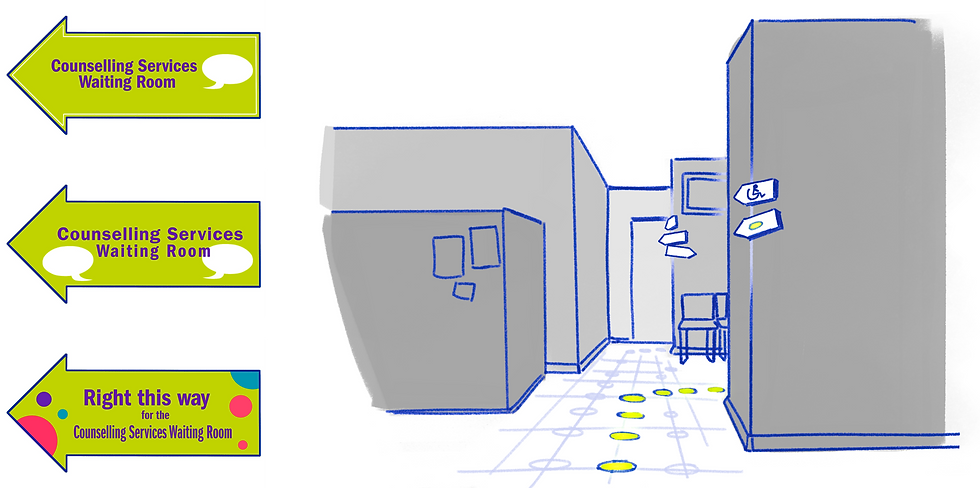
Once in the office, the navigational challenges continued. The directional signage was vague, and there's a confusing number of waiting rooms that can mislead students to wait in the wrong area.
Solution
Supported by insights gathered from direct interviews and campus staff, these initial hurdles informed improvements to the website's architecture, the email booking and registration process, and the physical wayfinding.
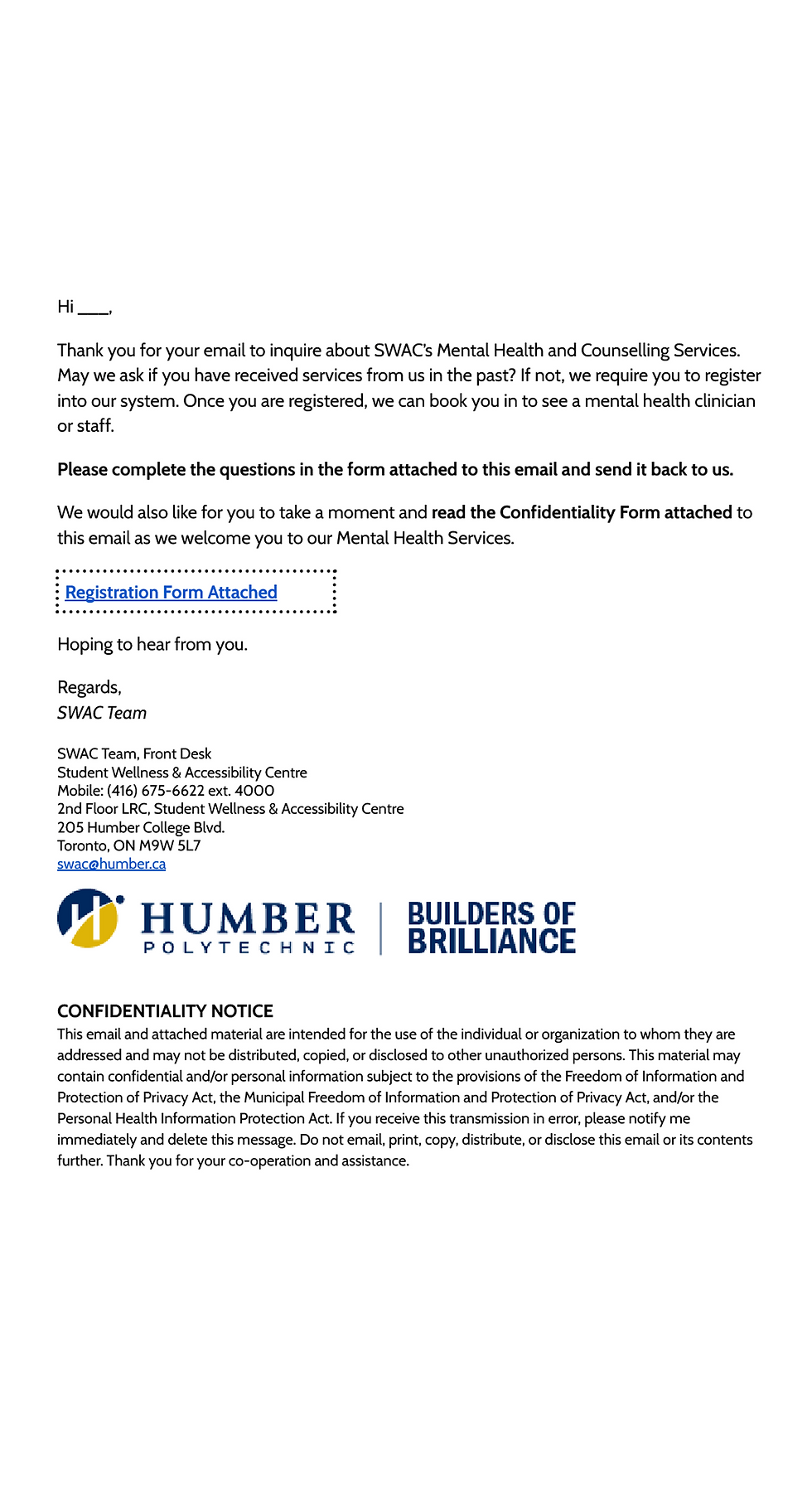
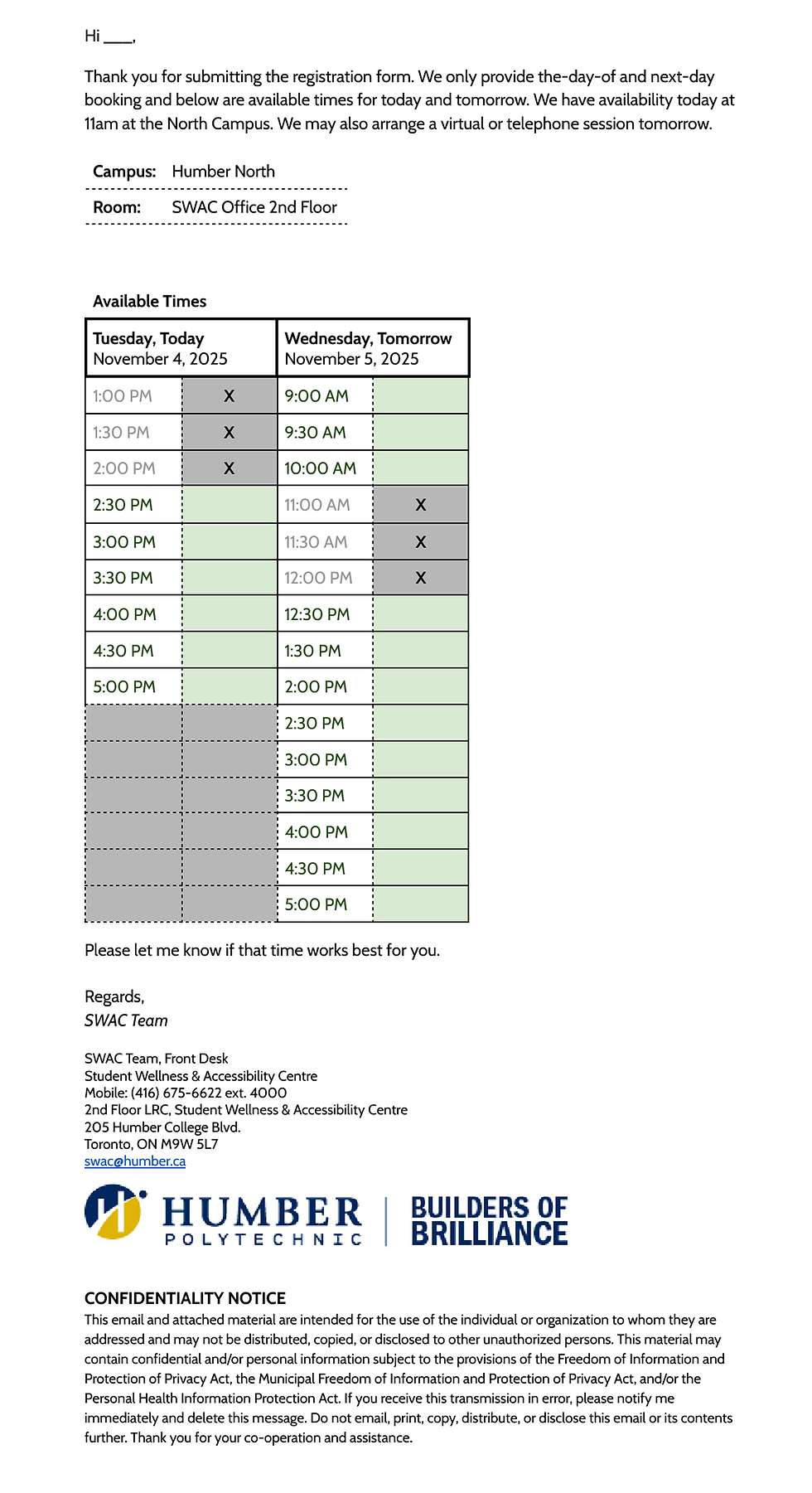
The first iterations of the email redesign introduced a staff signature, an accessible and visually clear scheduling format, and improved clarity in the registration flow, showing a distinction between international and domestic student information.
Field study findings revealed the SWAC emails referenced an external CMHA Toronto service at a different location, causing misinterpretation about which services were offered on campus. In response, my email redesign differentiated the services to enhance clarity and reduce misunderstanding.
I also conceptualized eye-level physical signage to help with direction in the office location.

Final Design
The stakeholder meeting with the director provided new insights that essentially shaped the final design for the email booking and registration process.
The director responded positively to our proposed solutions, but noted budget and website limitations. They also expressed interest in physical merchandise and clear wayfinding, and highlighted opportunities to develop video tutorials and refine the email process.
After the interview, the email design was adjusted to reflect the constraints. The SWAC logo was replaced to be Humber Polytechnic’s logo due to branding restriction, as they were not allowed to create a separate custom identity. Additionally, due to staff rotation, signatures were limited to only labelling themselves as the entity of SWAC, and not as an individual staff member.
These design updates were implemented and presented in a final stakeholder meeting.


4.5/5
Overall Experience Rating
Faster decision-making when completing tasks for students, supported by improved form design and readability in the new structured booking process.
15% - 30%
Increased Engagement with SWAC
Supplementary wayfinding tools, student-made tutorials, and clear communication within the new structured booking system, are predicted to increase student engagement by up to 30%.
+80%
Improved Wayfinding
Reduced confusion between SWAC services and the external provider CMHA Toronto. Enhanced wayfinding projected to decrease the time to locate the SWAC office by 50%, supported by efficient use of eye-level signage and video tutorial.
82%
Feasibility Impact
Ensured feasible implementation and stakeholder adoption proven by the alignment with Humber Polytechnic branding system and constraints.
Impact


Learnings
In the making of this project, I learned how aligning design decisions with stakeholder constraints are crucial to ensure real-world adoption. Although the booking and email processes were approved, there is room to clean up and refine the tone of voice and make it clear to better the student experience.
This project highlighted how small gaps in communication, like the unclear location for counselling, the lack of confirmation from staff email, and the overload of information in the wrong places, can make a huge impact in user confidence and can elevate their stress, especially for those who are new students.
Seeing everything on the whole, our work with SWAC demonstrated the value of combining digital solutions with the physical improvements, all founded by field research and speaking to the right people. The holistic approach helped us shape practical, user-centred designs that supported students in both online and in-person.